
Many pilgrims reach Makkah with a heart full of duas, hope, and excitement. They want their Umrah journey to feel calm, meaningful, and well planned. But when it comes to ziyarat places in Makkah, many travelers feel unsure.
Some people only know the names of famous places. Some have heard about Cave Thawr, Jabal Rahmah, or Jabal Al Nour, but they do not know what to expect there. Some families worry about transport, walking, heat, and elderly parents. Others are not sure which places are worth visiting when they have limited days in Makkah.
This is where a careful plan matters.
Makkah ziyarat is not only about going from one location to another. It is about seeing places that remind you of patience, sacrifice, dua, and the early days of Islam. These places can make the journey more personal when they are visited with respect and proper timing.
The purpose of this article is to give you a clear view of famous ziyarat in Makkah, how to plan the visit, what each location means, and how to avoid common stress during the trip.
If you are also reviewing travel cost, family comfort, and package options, you may read this article on cheap Umrah deals for families and budget travelers from USA as part of your wider Umrah planning.
What Does Makkah Ziyarat Mean for a Pilgrim?
“Makkah ziyarat” means visiting Islamic places in Makkah that carry religious, historical, or spiritual value. These visits are often done after Umrah or on a separate day during the stay in Makkah.
Ziyarat is not a condition of Umrah. A pilgrim can complete Umrah without visiting these sites. Still, many people add ziyarat because it gives them a deeper connection with the land of Makkah.
Some locations are linked with Prophet Muhammad, peace be upon him. Some are linked with Hajj. Some remind pilgrims of hardship, migration, mercy, or worship.
A good ziyarat visit should not feel rushed. It should give you time to see, reflect, and remember the story behind each place.
Why Should Pilgrims Know These Places Before Going?
Knowing the ziyarat places in Makkah before travel makes the visit more peaceful. You are not confused when the driver or group leader names a location. You already know why the place matters and what kind of visit to expect.
This is very important for families. Children may lose interest if they only sit in a vehicle and hear place names. But when parents explain the story in soft words, the trip becomes more valuable.
It also protects your energy. Some places need more walking. Some are better viewed from outside. Some are connected with Hajj and may be seen as part of a drive through tour. If you know this before going, you can plan better for elderly parents, kids, and anyone with health concerns.
Which Ziyarat Places in Makkah Should You Know?
There are many historical sites in Makkah. The most common ziyarat route often includes mountains, Hajj locations, mosques, and old areas connected with Islamic history.
Below are the key places every pilgrim should know.
1. Jabal Al Nour
Jabal Al Nour is among the most known Islamic places in Makkah. Its name means Mountain of Light. It is famous because Cave Hira is located on this mountain.
This place is deeply connected with the beginning of revelation. Many Muslims visit the area because it reminds them of the first moments of the Quran being revealed to Prophet Muhammad, peace be upon him.
The mountain can be seen from the lower area. Some people climb toward Cave Hira, but this climb is not suitable for everyone. It can be steep and tiring. Heat can make it harder.
For most families, viewing Jabal Al Nour from below and hearing the story may be enough. The value is not in pushing the body beyond comfort. The value is in remembering the event with respect.
2. Cave Hira
Cave Hira is located on Jabal Al Nour. It is the cave where Prophet Muhammad, peace be upon him, would spend time in worship before prophethood. It is also linked with the first revelation.
This place carries deep emotion for many pilgrims. It reminds them that the message of Islam began with quiet reflection, truth, and the command to recite.
If you plan to climb, go with full care. Wear proper shoes. Carry water. Avoid hot hours. Do not take elderly family members up the mountain unless they are physically fit.
It is also important to keep manners. The cave is a historical place, not a place where people should push, argue, or block others for photos.
3. Cave Thawr
Cave Thawr is linked with the Hijrah from Makkah to Madinah. Prophet Muhammad, peace be upon him, and Abu Bakr, may Allah be pleased with him, took shelter there during a dangerous moment.
This place teaches reliance on Allah during fear and pressure. For many pilgrims, it is a reminder that faith does not mean life has no tests. Faith means trusting Allah during tests.
Cave Thawr is on Jabal Thawr. The climb is difficult. It is not a light walk. Many visitors view the mountain from a distance instead of climbing.
Families should think carefully before attempting the climb. A peaceful visit from below is better than a stressful climb that leaves people exhausted for prayers later.
4. Jabal Rahmah
Jabal Rahmah is in the plain of Arafat. It means Mountain of Mercy. This place is often included in Makkah ziyarat tours because of its strong connection with Hajj.
Arafat is where Hajj pilgrims gather on the 9th of Dhul Hijjah. It is a place of dua, humility, and turning back to Allah. Jabal Rahmah reminds many people of mercy, forgiveness, and sincere prayer.
Outside Hajj, visiting Jabal Rahmah is not a Hajj ritual. It is a historical and spiritual visit. Pilgrims may make dua, but they should avoid any action that has no valid religious basis.
The best way to visit is with calm manners. Keep the stop short if the weather is hot. Families with children should stay together because the area can become busy.
5. Arafat
Arafat is one of the most important places connected with Hajj. Even if you are visiting for Umrah only, seeing Arafat can give you a stronger picture of the Hajj journey.
During Hajj, standing at Arafat is a main pillar. Outside Hajj season, visitors usually pass through or stop briefly during ziyarat.
The place reminds pilgrims of accountability and dua. It also shows the scale of Hajj, where large numbers of Muslims gather in worship.
When visiting Arafat, keep the purpose in mind. It is not just a stop on a travel route. It is a place that reminds the heart of Allah’s mercy and the final return.
6. Mina
Mina is known for its role during Hajj. It is the area where pilgrims stay in tents during specific days. It is also linked with the stoning ritual at Jamarat.
For Umrah visitors, Mina gives a visual idea of how Hajj is organized. Seeing the tent city and the large area can make the Hajj journey easier to picture.
A ziyarat tour may pass through Mina without long stops. This depends on route access, season, and local rules.
Mina is especially useful for people who may perform Hajj in the future. It gives them an early look at the movement between sacred sites.
7. Muzdalifah
Muzdalifah is between Arafat and Mina. During Hajj, pilgrims spend part of the night there after leaving Arafat.
This area teaches humility. Pilgrims gather under the open sky, leaving comfort behind for worship. It is a powerful reminder that every person stands before Allah without pride.
For Umrah travelers, visiting Muzdalifah during ziyarat gives context to the Hajj route. It shows how pilgrims move from Arafat toward Mina.
The visit is usually short. Most people see the area as part of a drive between Hajj locations.
8. Masjid Al Jinn
Masjid Al Jinn is a known historical mosque in Makkah. It is connected with reports about jinn listening to the Quran recited by Prophet Muhammad, peace be upon him.
Many pilgrims visit or pass by this mosque during ziyarat. The visit should be respectful and calm. It is a place connected with Islamic history, so loud behavior or casual treatment should be avoided.
If prayer is possible and timing allows, some visitors pray there. If not, passing by with respect is also fine.
9. Jannat Al Mualla
Jannat Al Mualla is a historic cemetery in Makkah. It is linked with many early figures from Islamic history.
This place can affect the heart deeply. Cemeteries remind people that life is short and every person will return to Allah.
Visitors should keep full respect. Speak softly. Avoid unnecessary photos. Make dua for the deceased and remember your own journey in this world.
For many pilgrims, this stop feels very different from mountain visits. It is quiet, serious, and reflective.
10. Masjid Aisha at Taneem
Masjid Aisha is located in Taneem. Many pilgrims know this mosque because it is often used as a miqat point for those in Makkah who intend to perform another Umrah.
This place is not the same as historical mountains or Hajj locations, but it is important for many Umrah travelers. People often go there to enter Ihram again before a second Umrah.
Pilgrims should avoid doing repeated Umrah only because others are doing it. Worship should be done with knowledge, physical ability, and sincerity.
If you are unsure about Ihram rules, ask a qualified scholar or your group leader before making plans.
How Should You Plan Your Ziyarat Route?
A good Makkah ziyarat plan starts with your energy level, not only with the place list. Many pilgrims make the mistake of adding too many stops and then feeling tired for prayers.
Here is a practical way to plan.
Step 1: Keep Umrah and prayers as the main focus
Your ziyarat should support your journey, not take over it. Complete Umrah with peace. Rest well. Then plan ziyarat when your body feels ready.
Step 2: Group locations by route
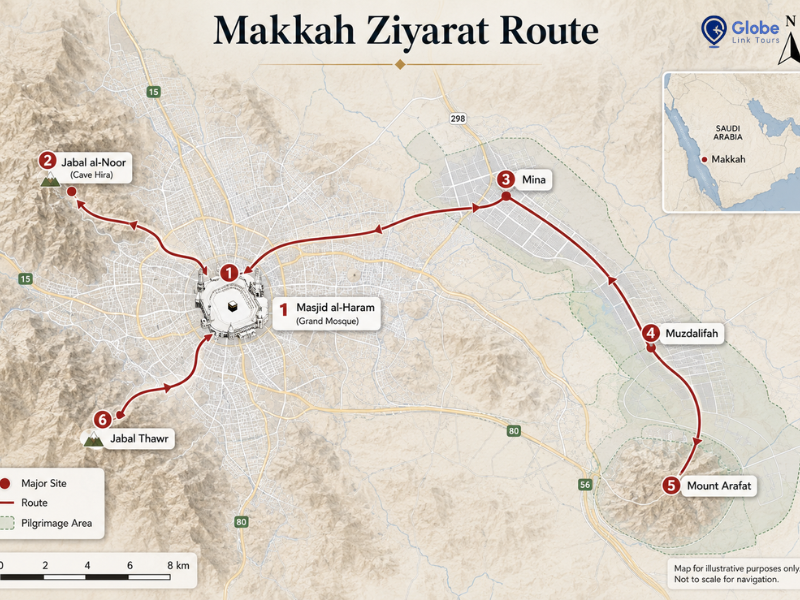
Some places can be seen together during 1 tour. A common route may include Jabal Al Nour, Jabal Thawr, Arafat, Mina, Muzdalifah, and Jabal Rahmah.
This saves travel time and avoids repeated transport bookings.
Step 3: Check who is traveling with you
A group of young adults can handle a longer route. A family with kids or elderly parents needs a softer plan. Wheelchair users may need extra care.
Do not plan based on what others are doing. Plan based on your own group.
Step 4: Avoid peak heat
Early morning is usually better. Late afternoon can also work in some seasons. Midday heat may make the trip hard.
Step 5: Ask what the tour includes
Some tours only drive past certain places. Some allow stops. Some include a short explanation. Some do not.
Ask before booking so your expectations are clear.
Step 6: Keep space for rest
Do not plan shopping, ziyarat, and long worship hours all in the same block. Your body has limits. Respect those limits.
Real World Example
A couple traveling with 3 children and an elderly father has 4 nights in Makkah. They want to see all major historical sites in Makkah, but they also want enough time in Masjid Al Haram.
Instead of doing a full day tour, they plan a 4 hour morning ziyarat after Fajr and breakfast. They visit Jabal Al Nour from below, pass by Jabal Thawr, stop at Arafat, see Jabal Rahmah, pass Mina and Muzdalifah, then return before the day becomes too hot.
They skip climbing because the elderly father has knee pain. The children are given 1 short story at each stop. The family returns with energy left for Zuhr and rest.
This kind of plan is balanced. It gives meaning without pressure.
Common Mistakes to Avoid
Mistake 1: Making the visit only about photos
Photos can be taken with respect, but the main purpose is reflection. Some pilgrims spend more time taking pictures than thinking about the place.
Mistake 2: Climbing without preparation
Jabal Al Nour and Jabal Thawr are not easy for every person. Lack of water, weak shoes, and hot weather can create health problems.
Mistake 3: Not checking elderly comfort
Parents may not say they are tired because they do not want to stop the group. Keep checking on them. Plan rest breaks before they become exhausted.
Mistake 4: Treating every local story as confirmed fact
Some stories are widely known. Others may be weak or disputed. Keep respect, but do not build belief on every story heard during a tour.
Mistake 5: Filling the schedule too tightly
A packed schedule can reduce peace. It is better to visit fewer places with focus than many places with stress.
Mistake 6: Forgetting that ziyarat is optional
No pilgrim should feel guilty if they miss some locations. Umrah has its own duties. Ziyarat is an added spiritual and historical experience.
Expert Tips for a Better Visit
Read short notes about each place before your tour. This makes the visit more meaningful.
Keep water with you at all times.
Wear soft walking shoes.
Use a private vehicle if you have elderly family members.
Ask the driver about stop time before starting the tour.
Avoid loud behavior at religious and historical places.
Do not climb mountains in extreme heat.
Keep children close in busy areas.
Carry small snacks if traveling with kids.
Make dua quietly where suitable.
How This Topic Supports the Bigger Umrah Plan
Ziyarat places in Makkah are part of a larger journey. They connect your heart with history, while Umrah connects your body and soul with worship.
A strong Umrah plan should cover more than flight and hotel booking. It should also include worship timing, rest, local transport, family needs, and meaningful site visits.
This is why the main Makkah ziyarat planning article should be used as the main pillar page. It can connect all related topics such as Makkah historical sites, Madinah ziyarat, Tawaf, Sai, family travel, and Umrah package planning.
For official city background and general location context, you can also review this public page about Mecca.
When Should You Consider Travel Support?
Travel support may be useful when you are coming from the USA, traveling with family, or visiting Makkah for the 1st time. It may also matter when your trip is short and you cannot afford poor planning.
Professional support can assist with flights, hotel area, visa needs, ground transport, and ziyarat timing. It can also reduce confusion for families who want a smooth journey without handling every detail alone.
Many travelers review umrah packages when they want hotel, transport, and travel planning arranged in 1 place.
The main goal should always be peace of mind. When travel details are clear, pilgrims can give more attention to worship and family.
Conclusion
The ziyarat places in Makkah carry deep value for pilgrims. Some places remind you of revelation. Some remind you of migration. Some show the route of Hajj. Some bring the heart closer to the reality of life and death.
You do not need to rush through every place. You do not need to climb every mountain. You do not need to copy another family’s schedule.
Visit with respect. Plan with care. Keep your health safe. Give your family enough time to rest. Most of all, keep worship at the center of the journey.
A meaningful ziyarat visit is not measured by the number of stops. It is measured by what stays in your heart after you return.
FAQs
What are the most famous ziyarat places in Makkah?
The most famous places include Jabal Al Nour, Cave Hira, Cave Thawr, Jabal Rahmah, Arafat, Mina, Muzdalifah, Masjid Al Jinn, and Jannat Al Mualla.
Is Cave Thawr hard to climb?
Yes, Cave Thawr is difficult to climb for many people. Elderly pilgrims, children, and anyone with health issues should be careful.
Can Umrah pilgrims visit Arafat?
Yes, Umrah pilgrims can visit Arafat as part of ziyarat. It is a historical visit outside Hajj season, not a Hajj ritual.
How many hours are enough for Makkah ziyarat?
Around 3 to 4 hours is enough for many families. Longer tours may be tiring, especially in hot weather.
Should I book ziyarat with transport?
Yes, transport is better for most pilgrims because many places are outside the Haram area. It is more comfortable for families and elderly travelers.