
Tawaf is 1 of the most emotional moments of Umrah.
Many first-time pilgrims dream about this moment for years. They imagine seeing the Kaaba, walking around it, raising their hands in dua, and feeling close to Allah in a way they have never felt before.
But when the real day comes, many people also feel nervous.
The crowd is big. The mosque is wide. Everyone is moving. You may not know where to start, what to recite, how many rounds to count, or what to do if you make a mistake. You may worry about losing your family, missing a tawaf step, or doing something wrong near the Kaaba.
That feeling is very normal.
This tawaf guide is written for first-time Umrah pilgrims who want clear guidance without confusion. It explains what tawaf is, how tawaf steps work, what tawaf around the Kaaba means, which tawaf dua you can read, and the main tawaf rules for Umrah.
Globe Link Tours supports travelers with umrah packages that can include travel planning, visa support, flights, hotels, and trip guidance so pilgrims can focus more on worship and less on travel stress.
This guide will walk with you calmly from the beginning to the end.
By the time you finish reading, tawaf will feel less confusing and more meaningful.
What Is Tawaf?

Tawaf means walking around the Kaaba 7 times in worship.
The Kaaba is the sacred house in Masjid al Haram in Makkah. Muslims face the Kaaba during prayer from every part of the world. During Umrah, pilgrims walk around it as an act of love, obedience, and devotion to Allah.
You can read more about the Kaaba from a general reference source.
Tawaf is not just walking in a circle.
It is a moment where the body moves, the tongue remembers Allah, and the heart turns away from daily worries. Each round reminds the pilgrim that life has a center. For a Muslim, that center is obedience to Allah.
During tawaf around Kaaba, every person looks different. Some are young. Some are elderly. Some are rich. Some are poor. Some speak Arabic. Some speak English, Urdu, Turkish, Malay, or other languages.
But all move in the same direction.
This is 1 reason tawaf is so powerful. It shows unity. It reminds you that every believer is part of something much bigger than personal life, work, money, and daily stress.
Why Tawaf Matters In Umrah
Tawaf is a core part of Umrah.
Without tawaf, Umrah is not complete. This is why it should not be treated like a quick activity or a travel photo moment. It is worship. It has rules, steps, manners, and deep spiritual meaning.
For many pilgrims, tawaf is also the moment when the reality of Umrah finally enters the heart.
Before tawaf, you may be busy with airport lines, hotel check in, transport, bags, and Ihram. But when you enter Masjid al Haram and see the Kaaba, everything changes. The heart becomes soft. Some people cry. Some become quiet. Some cannot believe they are really there.
That emotional moment should be protected.
This is why preparation matters. When you know the tawaf steps before entering the crowd, your mind stays calmer. You are not trying to figure out everything while standing near the Kaaba. You already know the path.
And when the mind is calm, the heart can focus better.
What Should You Know Before Starting Tawaf?
Before starting tawaf, make sure you are in the right state for worship.
For Umrah, you must be in Ihram before performing tawaf. Men wear the 2 Ihram cloths. Women wear modest clothing that covers properly according to Islamic guidance. You should also have wudu before tawaf.
Try to use the restroom before entering the tawaf area. Drink water, but do not drink so much that you feel uncomfortable during the rounds. Keep your slippers or shoes in a small bag if needed. Do not leave them in a random place where they may get lost.
Keep your phone secure. Keep your hotel card or group contact with you. If you are traveling with elderly parents or children, agree on a meeting point before entering the tawaf area.
This small planning can save you from panic later.
Many first-time pilgrims make 1 mistake. They think tawaf starts only when they are close to the Kaaba. In reality, tawaf can be done from different levels or areas of Masjid al Haram when needed. The main point is that you complete 7 full rounds around the Kaaba in the correct direction.
If the ground floor is too crowded, do not feel bad about using another level if allowed and suitable. Your safety matters.
Tawaf Steps For First Time Umrah Pilgrims
Step 1: Enter Masjid Al Haram With Respect
Enter the mosque calmly.
Do not rush. Do not push. Keep your voice low. This is not a regular public place. You are entering 1 of the most sacred places on earth.
Many pilgrims feel overwhelmed at this moment. That is natural. Take a breath. Make dua. Thank Allah for bringing you there.
If this is your first sight of the Kaaba, allow your heart to feel the moment. Do not make the phone your first reaction. Let your eyes and heart connect first.
Step 2: Move Toward The Tawaf Area
After entering, move toward the tawaf area carefully.
Follow signs and crowd control staff. Stay with your group if you have 1. If the crowd is moving slowly, accept the pace. Pushing will not make worship better. It can harm others and disturb your own focus.
If you are with elderly family members, keep them on the safer side of the crowd. Do not take them into the densest area near the Kaaba unless they are physically able.
Step 3: Start From The Black Stone Line
Tawaf starts from the line of the Black Stone.
You do not need to touch or kiss the Black Stone, especially when the crowd is heavy. Many first-time pilgrims think their tawaf is weak if they cannot touch it. That is not true.
If you can safely face or point toward the Black Stone area, do so. Say “Bismillah, Allahu Akbar” or simply “Allahu Akbar.” Then begin walking.
Safety is more important than forcing your way through people.
Step 4: Walk Around The Kaaba 7 Times
Walk around the Kaaba in the correct direction with the Kaaba on your left side.
Each full circle is 1 round. You must complete 7 rounds.
Do not stop in the middle unless needed. Do not walk against the flow. Do not cut through people roughly. Stay calm and move with the crowd.
Men may do ramal in the first 3 rounds during certain tawaf conditions, which means walking with a slightly quicker and stronger pace. But if the area is crowded, safety comes first. Do not bump into people to follow this.
Women do not do ramal.
Step 5: Make Dua During Tawaf
There is no single fixed tawaf dua required for every round.
You can make dua in your own language. You can ask Allah for forgiveness, peace, health, halal income, protection, family unity, guidance, and acceptance of Umrah.
This is a mercy.
Many pilgrims worry because they do not know Arabic duas by heart. Do not let this worry steal your focus. Allah knows every language and every feeling in your heart.
You can read Quran, say dhikr, send blessings upon the Prophet, or make personal dua.
Between the Yemeni Corner and the Black Stone, many pilgrims read:
Rabbana atina fid dunya hasanah wa fil akhirati hasanah wa qina adhaban nar.
This dua asks Allah for good in this life, good in the next life, and safety from the punishment of the Fire.
Step 6: Count Your Rounds Carefully
Counting tawaf rounds can become difficult in a crowd.
You may start with full focus, then get emotional, then forget if you are on round 4 or 5. This happens often.
Use a small counter ring if you have 1. You can also count with fingers or use a trusted person in your group. Avoid using your phone too much because it can distract you.
If you are unsure between 2 numbers, many scholars advise building on the lower number to be safe. For personal religious rulings, ask a qualified scholar or your group guide.
The best approach is to avoid confusion from the start.
Before tawaf, say to yourself: “I will stay calm and count each round clearly.”
Step 7: Complete The 7th Round
When you finish the 7th round, do not suddenly stop in the walking path.
Move out carefully to the side. Look around before changing direction. The crowd behind you is still moving.
This small action protects others and keeps the flow smooth.
After tawaf, you will usually pray 2 rakats if possible, often behind Maqam Ibrahim if space allows. If that area is crowded, you can pray elsewhere in the mosque.
Do not push others just to pray in a specific spot.
Allah sees your intention.
Step 8: Drink Zamzam
After the 2 rakats, many pilgrims drink Zamzam.
Drink with gratitude. Make dua. This is a special moment. Ask Allah for what your heart truly needs.
Some people ask for health. Some ask for forgiveness. Some ask for peace in the family. Some ask for children. Some ask for strength to leave sins.
Do not rush this moment.
Step 9: Continue To Sa’i
After tawaf and prayer, Umrah continues with Sa’i between Safa and Marwah.
Tawaf prepares the heart. Sa’i reminds the believer of effort, patience, trust, and hope. Together, these rituals carry deep meaning for the whole journey.
Real Life Example: A First Time Family Doing Tawaf
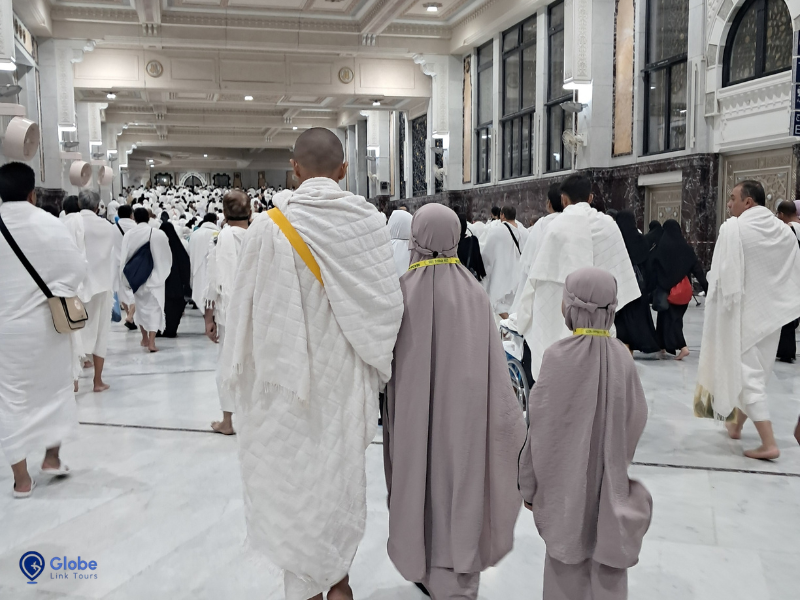
Imagine a family traveling from the USA for Umrah.
The father has planned this trip for many months. The mother is worried about the children. The grandparents are excited but tired from the long flight. Everyone has watched videos, but none of them has done tawaf before.
They enter Masjid al Haram after resting at the hotel.
At first, the children are amazed by the size of the mosque. The grandmother becomes emotional when she sees the Kaaba. The father tries to keep everyone together. The mother reminds the children not to run.
They move toward the tawaf area slowly.
The first round feels confusing. The crowd is bigger than expected. The father almost forgets where the Black Stone line is. The mother starts counting rounds on her fingers. The grandmother walks slowly, so the family moves at her pace.
By round 3, they become calmer.
The father stops worrying about doing everything perfectly and starts making dua. The mother asks Allah to protect her children. The grandparents pray with tears. The children begin to copy the adults and say “Allahu Akbar” softly.
By round 7, the whole family feels different.
They are tired, but peaceful. They came with stress. They leave tawaf with gratitude.
This is why tawaf is not only a physical act. It becomes a family memory. It becomes a spiritual turning point.
Common Mistakes During Tawaf
Mistake 1: Trying To Touch The Black Stone At Any Cost
Many pilgrims push through the crowd to touch or kiss the Black Stone.
This can hurt people. It can break your focus. It can cause anger in a place where the heart should be soft.
If it is safe, you may touch it. If it is not safe, point from a distance and continue.
Your tawaf is valid without touching it.
Mistake 2: Thinking There Is Only 1 Correct Tawaf Dua
Some first time pilgrims carry long dua books and feel stressed because they cannot read while walking.
Dua books can be good if used calmly. But you do not need a fixed dua for every round. You can speak to Allah from your heart.
Ask for what matters. Ask with humility. Ask with hope.
Mistake 3: Taking Too Many Photos
Photos may seem harmless, but too much phone use can damage the spiritual feeling of tawaf.
Some people record videos while walking and block others. Some turn their backs carelessly. Some become more focused on the shot than the worship.
Keep memories, but do not lose the purpose.
Mistake 4: Losing Count Of Rounds
This is very common.
Use a counting method before you begin. Do not wait until round 5 to realize you are unsure. If you travel with a group, agree who will count.
Mistake 5: Pushing Elderly Pilgrims
Crowds can make people impatient.
But tawaf is worship. Your manners are part of that worship. Do not push, shout, or block people. Be gentle with older pilgrims, wheelchair users, children, and women.
A soft heart matters more than reaching the front.
Mistake 6: Walking Too Close To The Kaaba Without Need
Many first time pilgrims think closer is always better.
But the closest area can be extremely crowded. If you are weak, tired, elderly, or with children, a slightly wider path may be safer and calmer.
A peaceful tawaf with focus is better than a stressful tawaf full of fear.
Mistake 7: Forgetting That Tawaf Is Worship
Some people treat tawaf like a travel checklist.
They rush through it, talk loudly, answer calls, or complain about the crowd. This reduces the beauty of the moment.
Before you begin, remind yourself why you came.
You are not only completing a step. You are standing before Allah with hope.
Tawaf Rules For Umrah

Tawaf rules for Umrah are important because they protect the meaning and order of the ritual.
You should be in Ihram for Umrah tawaf. You should have wudu. You should start from the Black Stone line. You should complete 7 full rounds. You should move with the Kaaba on your left side. You should avoid cutting through the Hateem area because that would not count as going fully around the Kaaba.
You should keep your body covered properly. Men should follow Ihram rules. Women should maintain modest dress and avoid anything that breaks Islamic manners.
If your wudu breaks during tawaf, many scholars say you should renew wudu and continue according to guidance. Since rulings can differ in details, ask a qualified scholar or group guide if this happens.
Do not panic if a mistake happens.
Many pilgrims face small issues during their first Umrah. The right response is calm correction, not fear. Islam is not about making worship impossible. It is about sincerity, obedience, and doing your best with proper guidance.
Tawaf Around Kaaba: What The Movement Teaches The Heart
Tawaf around Kaaba is a physical action with a deep inner message.
You walk around 1 sacred center. This reminds you that your life also needs 1 sacred center. Work, money, family, goals, and travel all have their place. But none of them should become bigger than Allah in the heart.
Every round can carry a meaning.
Round 1 can be for forgiveness.
Round 2 can be for gratitude.
Round 3 can be for your parents.
Round 4 can be for your spouse and children.
Round 5 can be for your future.
Round 6 can be for the Ummah.
Round 7 can be for acceptance.
This is not a fixed rule. It is a way to keep the heart awake.
Many people arrive in Makkah carrying silent pain. Some carry financial stress. Some carry family conflict. Some carry regret. Some carry grief. Some carry private worries they never say out loud.
Tawaf gives the heart a place to release those burdens.
You may not leave with every problem solved. But you may leave with strength, patience, and trust.
That is a gift many pilgrims remember for life.
What Tawaf Dua Should You Read?
There is no required tawaf dua for each round.
You can make dua from the heart in any language. This is very comforting for first time pilgrims. You do not need to sound perfect. You do not need long Arabic phrases if you do not know them.
You can say:
Allah, forgive me.
Allah, accept my Umrah.
Allah, protect my family.
Allah, guide my children.
Allah, grant me halal income.
Allah, remove arrogance from my heart.
Allah, give me peace.
Allah, bring me back to Your house again.
Allah, make my last deeds my best deeds.
You can also read Quran, say SubhanAllah, Alhamdulillah, Allahu Akbar, La ilaha illa Allah, and send salawat upon the Prophet.
The strongest dua is not always the longest. Sometimes 1 honest sentence from a broken heart carries more feeling than many pages read without focus.
Advanced Tips For A Better Tawaf
Go At A Suitable Time If You Can
Crowds change throughout the day.
Some times are busier than others. After prayers, entry and exit areas can become crowded. Late night or certain off peak times may feel calmer, depending on the season.
If you are traveling with elderly family members, ask your guide or hotel staff about suitable timing.
A calmer tawaf can make a big difference for first-time pilgrims.
Keep Your Group Small During Tawaf
Large groups are harder to manage in a moving crowd.
If you are traveling with many relatives, consider breaking into smaller groups based on walking speed and physical ability. Young adults can go together. Elderly members can go with patient caregivers.
This reduces stress.
It also prevents the common problem where 1 person walks fast and another person gets lost behind.
Prepare Your Duas Before You Arrive
Before your trip, write down the duas that matter most to you.
Think about your parents, spouse, children, health, work, debts, forgiveness, and guidance. Think about people who asked you to make dua for them.
During tawaf, you may become emotional and forget what you wanted to ask. A small dua note can keep you focused.
But do not stare at the note the whole time. Use it only when needed.
Respect The Space Of Others
Tawaf is shared worship.
You are not alone. Everyone has traveled far. Everyone wants acceptance. Everyone is tired. Everyone is hoping for mercy.
When you remember this, your behavior becomes softer.
Do not block the path for selfies. Do not shout at your group. Do not walk with your elbows out. Do not become angry if someone touches you by mistake.
Crowds are part of the test.
Patience is part of the reward.
Keep Children Emotionally Ready
If you bring children, explain tawaf before entering Masjid al Haram.
Tell them there will be many people. Tell them they must stay close. Tell them not to run. Give them a small task, such as counting rounds or saying a short dua.
Children often respond better when they know what is happening.
This can turn tawaf into a beautiful memory instead of a stressful event.
Care For Elderly Pilgrims
Elderly pilgrims may feel shy to say they are tired.
Watch their pace. Ask gently. Keep water nearby. Avoid peak crowd areas when possible. Consider wheelchair support if needed and allowed.
Do not rush them.
For many elderly parents, Umrah is a dream of a lifetime. Protect their dignity during the journey.
Related Subtopics For A Fuller Umrah Journey
Tawaf is 1 part of a larger spiritual journey.
After Umrah, many families want to visit important sites in Makkah and Madinah. These visits are not part of the required Umrah rites, but they can add historical and spiritual context.
In Makkah, families often want to know which places are suitable for first time pilgrims, how much time to give each visit, and how to manage children or elderly parents during local travel. A Makkah ziyarat guide for families and first time pilgrims can support this part of the journey.
In Madinah, many travelers feel a deep emotional connection because of the Prophet’s Mosque. They may want to visit major ziyarat places in Madinah for Umrah travelers, while keeping respect, time, and comfort in mind.
These topics matter because Umrah is not only about reaching Makkah. It is about returning home with stronger faith, clearer knowledge, and memories that stay with the whole family.
Travelers who want budget planning can also read about cheap umrah deals to compare timing, package value, and family travel options.
When Should You Get Expert Support?
You may need expert support if this is your first Umrah, if you are traveling with elderly parents, if your family is large, or if you feel unsure about visas, flights, hotels, ground transport, or the order of Umrah steps.
Many people think they can handle everything alone, then they feel stressed when small issues pile up.
The hotel may be far from Haram. The visa timing may cause pressure. Flight arrival may be late at night. Family members may get tired. Children may need rest. Elderly parents may not walk as much as expected.
Good planning does not remove all tests, but it reduces avoidable stress.
A travel services team can guide you on package timing, hotel location, transport needs, and general trip planning. The goal is not to make the journey feel commercial. The goal is to give your worship more space.
When the travel side is organized, your mind has more room for tawaf, dua, prayer, and reflection.
Future Trends In Umrah Travel And Tawaf Planning
Umrah travel is changing.
More families now plan from the USA with online bookings, digital visas, mobile apps, hotel comparisons, and flexible flight routes. Many first time pilgrims watch videos before they travel, but videos alone do not always prepare them for the real feeling of the crowd.
Future Umrah planning will likely focus more on clear guidance, family comfort, elderly care, and better pre-trip education.
Pilgrims want more than a package price. They want to know how far the hotel is from Haram, how transport works, when to perform Umrah, how to avoid crowd stress, and how to prepare their heart.
This is where strong guidance matters.
A well-planned Umrah journey should answer both practical and emotional questions.
Where will we stay?
How will we reach the hotel?
When should we do tawaf?
What if my parent gets tired?
What if I forget the tawaf steps?
What duas should I make?
What comes after tawaf?
The future of Umrah support is not only about booking. It is about guiding people with care.
Conclusion
Tawaf is not something to fear.
It is a beautiful act of worship that becomes easier when you know the steps, rules, and purpose. You begin from the Black Stone line. You walk 7 rounds around the Kaaba. You make dua. You remember Allah. You complete the rounds with patience and respect.
You do not need perfect Arabic.
You do not need to touch the Black Stone.
You do not need to be closest to the Kaaba.
You need sincerity, calm effort, and correct guidance.
If you are planning your first Umrah, take time to prepare before you travel. Read the tawaf steps. Write your duas. Speak with someone who knows the journey. Plan for your family’s comfort. Think about the elderly. Think about the children. Think about your own heart.
When you stand near the Kaaba, the world may feel very big and very small at the same time.
Big because Muslims from every place are there.
Small because your heart knows it is standing before Allah.
May your tawaf be accepted. May your Umrah be full of peace. May your journey bring you closer to Allah and return you home with a cleaner heart.
FAQs
What is tawaf in Umrah?
Tawaf is walking around the Kaaba 7 times as an act of worship. It is a required part of Umrah.
How many tawaf steps are there?
The main tawaf steps are: enter Masjid al Haram, start from the Black Stone line, walk 7 rounds, make dua, pray 2 rakats, drink Zamzam, then continue to Sa’i.
Can I make tawaf dua in English?
Yes. You can make tawaf dua in English or any language. Allah knows what is in your heart.
Do I have to touch the Black Stone?
No. If the area is crowded, do not push. You can point toward it from a distance and continue tawaf.
What happens if I forget my tawaf round count?
Try to count carefully from the start. If you become unsure, ask a qualified guide or scholar. Many pilgrims use the lower number to stay safe.
Can elderly pilgrims do tawaf on another level?
Yes, when suitable and allowed, pilgrims can perform tawaf from other levels of Masjid al Haram. This can be easier for elderly travelers during heavy crowds.
Is tawaf valid without Arabic duas?
Yes. Arabic duas are good, but your tawaf is not invalid only because you made dua in your own language.