
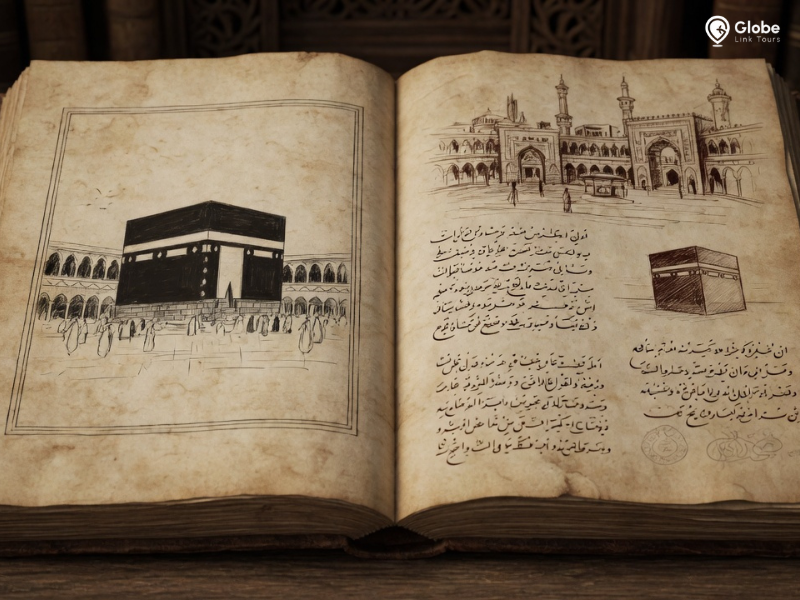
People search for first depiction of Kaaba because they want more than a quick fact. They want to know when the Kaaba first appeared in old images, drawings, manuscripts, maps, and historic Mecca illustration. Many travelers also ask this before booking a 5 night luxury Umrah package because the Kaaba is the heart of their Makkah visit.
This topic is sensitive and beautiful at the same time. The Kaaba is not a normal building in Islamic life. It is the qibla direction for Muslims during prayer. It is the center of tawaf during Hajj and Umrah. It is a sacred house connected with Prophet Ibrahim, Prophet Ismail, Makkah, and Masjid al Haram.
So when people look for the earliest Kaaba image, they should also understand the sacred background. An old picture can be interesting, but the Kaaba’s value is much bigger than any image.
First Depiction Of Kaaba In Clear Words
The safest answer is this: the earliest known understanding of the Kaaba comes first through Islamic revelation, early Muslim memory, and written description. Later, visual depictions appeared in manuscripts, maps, pilgrimage guides, tiles, drawings, and paintings.
There is no single public image that every historian accepts as “the first depiction of Kaaba” in a final and easy way. Different people mean different things by depiction. Some mean the first written description. Some mean the first manuscript plan. Some mean the first painted view. Some mean the first accurate eyewitness image.
This is why careful wording matters.
A British Library catalogue record describes a 16th century Ottoman Turkish manuscript copied in 1564 to 1565 CE that includes a plan of Mecca with the Kaaba at the center. The Khalili Collections also record a dated 1582 copy of Futuh al Haramayn, a pilgrim guide that illustrated stations of Hajj and rituals. These are not the only old records, but they show that Kaaba manuscript image traditions were present in early modern Islamic material.
Text, Memory, Manuscripts, And Later Images
To understand this subject properly, think in layers.
The first layer is sacred memory. Muslims know the Kaaba through the Quran, hadith, prayer direction, Hajj, Umrah, and the long memory of the Muslim community.
The second layer is written description. Muslim scholars, travelers, and historians wrote about Makkah, Masjid al Haram, tawaf, and the Kaaba across many centuries.
The third layer is visual record. This includes manuscript images, city plans, maps, tiles, prints, photographs, and museum objects.
When people ask about the first depiction of Kaaba, they often jump straight to images. But in Islamic history, the sacred meaning of the Kaaba was carried strongly through worship, speech, text, and memory before images became more common.
This makes the topic richer. It is not only about art. It is also about faith, travel, memory, and respect.
Early Visual Records Of Makkah And The Kaaba
Old Kaaba visual records often show the Kaaba inside the sacred mosque. Many images are not realistic like a modern photo. Some are symbolic. Some are map like. Some are made to guide pilgrims. Some were created as devotional or memory objects.
A 17th century British Museum tile shows the sanctuary at Mecca, with the Kaaba at the center and nearby features around it. The museum record describes the Black Stone and the four Sunni law school structures around the Kaaba area.
This kind of object shows that Muslims and Islamic artists did record the sacred space visually. But the purpose was not always the same as modern photography. It could be for memory, devotion, teaching, or marking a pilgrimage.
For a pilgrim, this matters because old images can open a window into the way people remembered Makkah before phones, cameras, and digital maps.
Old Kaaba Drawing And Manuscript Views
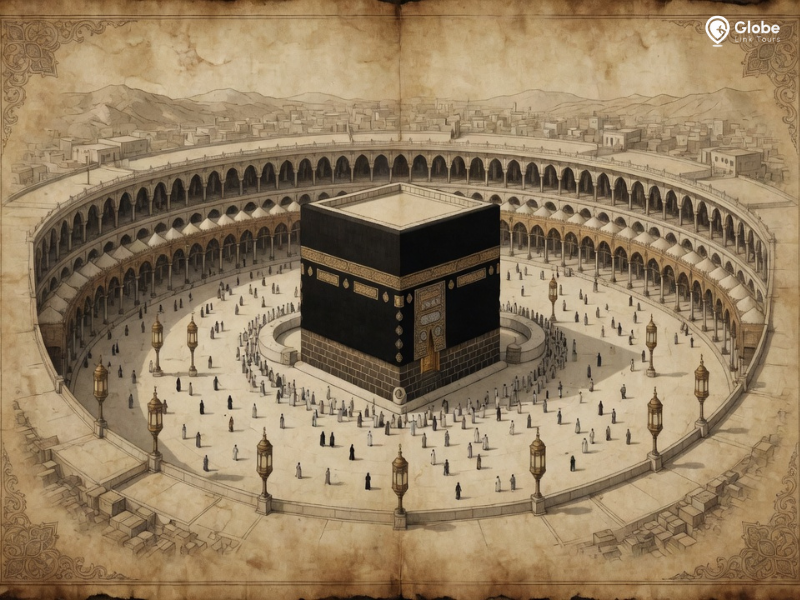
An old Kaaba drawing may look very different from a modern photo. The Kaaba may appear larger than nearby buildings. The mosque may be drawn from above. Some objects may be shown in a flat layout.
This is not always a mistake. Many older Islamic manuscript images used a visual style that helped the viewer understand sacred space, not just copy what the eye sees.
A Kaaba manuscript image might place the Kaaba at the center because that is its spiritual and ritual position. The image may show tawaf space, gates, minarets, or nearby structures in a way that is clear for the reader.
So when viewing an old Kaaba drawing, do not judge it only by modern photo rules. Ask what the image was trying to show. Was it a guide? Was it a memory image? Was it a map? Was it a devotional object?
This gives a better reading of the image.
Kaaba Images In Pilgrim Guides
Pilgrim guides played an important role in showing sacred places to people who were traveling for Hajj and Umrah. Some guides included views of Makkah and Madinah, along with ritual stations.
The Khalili record for Futuh al Haramayn describes it as a Persian verse guide for pilgrims, with illustrations of pilgrimage stations and rituals. It also notes that the work was widely copied in the 16th century in Ottoman Turkey.
This helps explain why many old Kaaba images are connected with travel and worship. People needed to understand the route, places, and actions connected to pilgrimage.
Today, travelers may use blogs, maps, videos, and apps. In earlier times, manuscripts and illustrated guides gave pilgrims a mental picture before or after the journey.
This same need still exists. A traveler preparing for Makkah may also check salah time in Makkah so visits to Masjid al Haram feel less rushed and more organized.
Reliability Of Historic Mecca Illustration
Historic Mecca illustration can be useful, but it must be read carefully. Not every old image is fully accurate. Some images are symbolic. Some are based on memory. Some are copied from earlier works. Some show the sacred space in a mixed view from above and from the side.
The Khalili Collections describe a circa 1845 panoramic view of Mecca as a very accurate eyewitness record of the city. The record says it combines a city plan with a bird’s eye view and calls it the earliest known accurate eyewitness record of Mecca.
This is important. The phrase “accurate eyewitness record” is not the same as “first depiction.” An older image may exist, but a later image may be more accurate. This is why the topic needs careful language.
When reading about earliest Kaaba image, watch the exact claim. Is the writer saying first known picture, first manuscript plan, first photo, first printed view, or first accurate eyewitness record? These are different things.
Sacred Respect In Visual Study
The Kaaba should never be treated like a mystery object for clicks. It is the holiest site in Islam. Visual history should bring respect, not showy claims.
Some readers feel disappointed when they do not get 1 final image called the first depiction. That feeling is understandable. People like clear answers. But sacred history is often carried through many kinds of records.
A careful answer is better than a loud one.
The Kaaba’s importance does not depend on an old drawing. Its honor comes from its place in Islam, its link with worship, and its role as the qibla.
For travelers planning Makkah and Madinah together, sacred context also includes places outside Makkah. For example, Masjid e Quba in Madinah has its own deep place in Islamic memory and ziyarat planning.
Step By Step Reading Method For Old Kaaba Images
1. Check The Type Of Record
First see if it is a manuscript, map, tile, painting, print, or photo. Each type has a different purpose.
2. Check The Date And Source
Look for the date, collection name, catalogue record, or museum note. A clear source gives more trust.
3. Read The Image Purpose
Some images were made for pilgrims. Some were made as memory objects. Some were part of books. Some were made as city views.
4. Compare With Other Records
Never depend on only 1 viral image. Compare it with museum records, manuscript records, and serious historical notes.
5. Keep The Sacred Meaning Central
The image is not the main point. The Kaaba’s role in prayer, tawaf, and Muslim unity is the main point.
Real Reader Example Before Umrah
Imagine a young student preparing for Umrah with his family. He sees an old Kaaba image online and reads a caption saying, “First image of the Kaaba ever.”
At first, he believes it. Then he checks more carefully. He notices that another museum has an older manuscript plan. Another collection has a later but more accurate city view. A different source talks about early photography.
Now he understands the topic better. The phrase “first depiction” needs context.
When he reaches Makkah, he is not only thinking about the old image. He is thinking about generations of Muslims who faced the Kaaba in prayer before cameras existed. This makes his visit deeper and more calm.
If the same family plans ziyarat in Makkah, reading about Mount Arafat in Makkah can add more sacred context to the journey.
Errors That Create Wrong Ideas
Treating One Viral Image As Final Proof
Many images online are shared without proper date or source. A viral post is not the same as a historical record.
Mixing Description With Depiction
A written description is not the same as a drawing or painting. Both are valuable, but they are not the same type of record.
Judging Old Art Like A Modern Photo
Old manuscript images often used symbolic layout. They were not always trying to look like a camera view.
Ignoring The Sacred Role Of The Kaaba
The Kaaba is not only an art subject. It is the qibla and the center of tawaf.
Forgetting Source Safety
Some sites copy images without context. Museum and library records are better places to view old material.
Careful Notes For Pilgrims And Students
Use museum, library, and known collection records when reading about old Kaaba drawings. These sources usually give dates, material, place, and object notes.
Be careful with social media captions. Many are written to get attention, not to give full context.
When sharing an old Kaaba image, add respect. Do not use jokes, edits, or dramatic claims. The subject is sacred for Muslims.
For families, this topic can be a good way to prepare children before Umrah. It shows that Muslims loved and remembered Makkah across generations.
For travelers who want more time in Makkah and Madinah, a 7 night luxury Umrah package can give more breathing space for worship, rest, and sacred visits.
Kaaba Images And The Wider Makkah Story
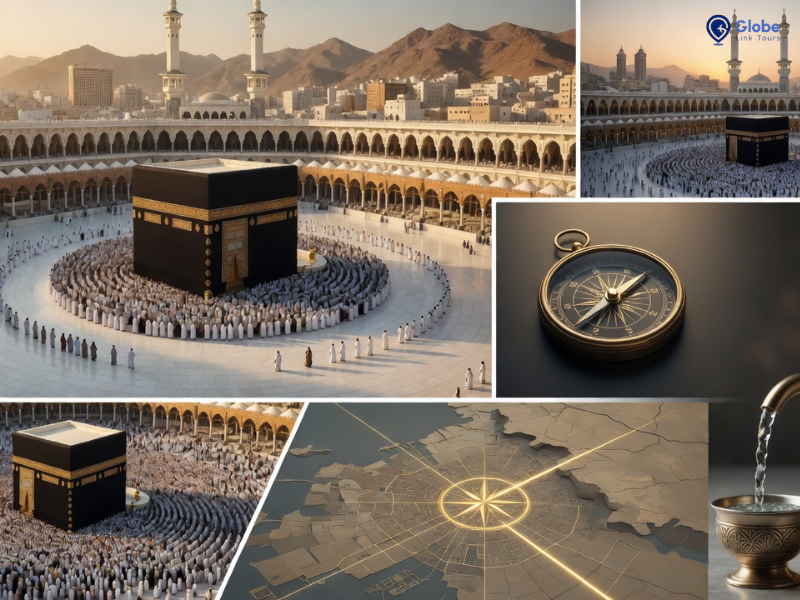
The first depiction of Kaaba is only 1 part of a bigger story. The Kaaba is connected with Masjid al Haram, tawaf, qibla, Zamzam, Maqam Ibrahim, the Black Stone, and the history of Makkah.
For a traveler, this topic should not stay as a small art question. It should open a wider view of worship and place.
A strong Makkah plan includes:
Prayer timing
Hotel distance from Masjid al Haram
Tawaf timing
Rest for elders
Ziyarat schedule
Madinah transfer
Family meeting point
Enough time for dua
For longer journeys, a 10 night premium Umrah package can suit travelers who want more time to move with calm between worship, rest, and travel.
Old images help us see memory. A real visit helps us feel the place.
Travel Support For A Calm Umrah Plan
Many first time pilgrims feel confused before travel. They may know the Kaaba is important, but they may not know hotel distance, prayer timing, transport, or the best way to manage family movement.
Globe Link Tours supports travelers with Umrah packages, visa assistance, hotels, flights, and route planning. The aim is to make the trip clear before departure, so the pilgrim can focus more on worship after reaching Saudi Arabia.
A short stay through a 5 night premium Umrah package may suit travelers with limited days. Longer stays can suit families who need more rest and better pacing.
Near the final stage of research, readers can view old visual material through safe museum and library records. A museum collection normally means a group of cared for objects held, recorded, and studied by a museum. This is much safer than trusting random image posts without dates or details.
Summary
The first depiction of Kaaba is not a topic with 1 easy image answer for every case. The earliest knowledge of the Kaaba comes through revelation, Muslim memory, and written description. Later visual records appear in manuscripts, maps, pilgrim guides, tiles, city views, and photographs.
Some old Kaaba images are symbolic. Some are map like. Some are more accurate. A later eyewitness record may be more detailed than an earlier drawing.
The best way to understand earliest Kaaba image claims is to check the date, source, object type, and purpose. Most of all, keep the sacred role of the Kaaba central.
The Kaaba is not important because of an old image. It is important because it is the qibla, the center of tawaf, and the Sacred House loved by Muslims across the world.
FAQs
Earliest Known Kaaba Depiction
There is no single easy answer accepted for every meaning of depiction. Early knowledge comes through Islamic text and memory, while later manuscripts and maps show visual records.
Old Kaaba Images And Trust
Some old Kaaba images are useful, but they must be checked with date, source, and context. Museum and library records are safer than random online posts.
Kaaba Manuscript Image Meaning
A Kaaba manuscript image may show the Kaaba as part of Makkah, Hajj routes, or sacred mosque layout. Some images are symbolic, not photo like.
Historic Mecca Illustration Value
Historic Mecca illustration can show how people remembered and recorded the sacred city. It should be read with care and respect.
Safe Places For Old Kaaba Images
Museum collections, library catalogues, and known Islamic art collections are safer places to view old Kaaba images with proper records.